Time keeps tickin' like a melancholy friend
Ticks the beginning and the middle and the end
But if I close my eyes and just pretend
There is shelter in this song
Like a river flowin' home...Yesterday marked the one year anniversary of the death of Alvine Clausen, my wife's grandmother, and the woman who raised her. (To see more about Alvine, and why she was so special to us, please read these two posts:
Goodnight, Dear Saint, and
Bookends.) Last night, Sami's mother - who lived with Alvine for the last two decades of her life - came over for dinner, not wanted to spend this anniversary alone. We never directly mentioned Alvine, though through three people who were shaped by both her genes and her presence in their lives (if you're keeping score at home, Adam is the third, having more in common with his maternal great grandmother than he is ever likely to notice) her memory filled our time together.
Death, and the remembrance of it, always leads me to meditate on the nature of time. For me, in a very existential way, death and time have been forever linked. I remember as a little kid, running circles around my bedroom, unable to sleep late at night, running from the specter of the inexorable passing of time and the inevitability of death. It is time that links the three sufferings first noticed by the Buddha as he snuck out of the shelter of his father's palace: old age, sickness, and death. As Howard Schnellenberger famously said (about something altogether more optimistic), "The only variable is time."
We will all die. The only variable is time. We will all become ill. The only variable is time. And, if we are lucky, we all grow old. The only variable is time. Time, as Steven Delopoulos sang in his song "Jungle Train," "keeps tickin' like a melancholy friend." In the Western model, the model that shapes our unconscious understanding and even the way that we perceive everything else, time might best be described as a train that chugs along in a straight line, a single direction, with perfect precision and a singleness of purpose. With it all things come. In it, all things pass away.
It was the unrelenting nature of time that haunted me as a child. I could not stop it. I could not slow it down. I could not persuade it to change course. Its slow but steady march told me in a voice that I could not ignore that all things are impermanent, even me; that all moments are impermanent, even the ones I would cling to. This impermanence, so evident from the silent march of time, is at the heart of the First Noble Truth of the Buddha, a truth that I did not hear until much later in life, but that I understood from the first moments of consciousness:
Life is suffering.While this, in its most common English translation, sounds extraordinarily pessimistic, it is neither optimistic nor pessimistic, but instead merely a simple statement of fact. All life is marked by suffering, by
dukkha, by a "dissatisfactory" quality. That dissatisfactory quality is its impermanence. Impermanence, unless we truly understand it for what it is, turns even our greatest moments of joy into occasions of great sorrow, as we realize that while we seem happy
now, this too shall pass. This moment, like all other moments, will go as quickly as it came, leaving with it the emptiness that comes from clinging to a moment of joy only to watch it, like so many others, slip through our grasp.
I remember as a young child sitting in the back seat of my parents' car - I think it was the old Mercedes that my Dad loved so much back then, though it had seen its best days long before he ever saw it - thinking about the impermanent nature of life in the face of the inexorable passing of time. I was haunted by the possibilities that presented themselves to me.
Life was either finite or infinite; impermanent or permanent. If it was the former, then I would die, the flame of my consciousness extinguish. There would be no more "me." That was unimaginable. But, if it was the later, perhaps that would be worse. I would be subject to the endless passing of time, stretched out forever without end.
Those were the choices as I understood them. Those
are the choices as most of us understand them. Either we are subject to the final extinction of death, or, we are not. And, if we are not, then still subject to time (for we cannot imagine anything without the passing of time) then we must eventually feel like Bilbo Baggins just before he gave up the ring of power, stretched thin like too little butter on too much toast.
So, death and the remembrance of it drive me to meditate on time. This meditation is not necessarily a philosophic one. It does not drive me to re-read my volumes of Augustine and Aquinas, testing the internal and experiential logic of their distinction between time and eternity. It does not drive me to posit a Scholastic "arch of time" beyond which lies a metaphysical realm not subject to time's eternal march. It does not drive me to mentally explore the metaphysical nature of time, like the Einstein character in Alan Lightman's first novel. And, it does not drive me to try to imagine the unimaginable, existence and even consciousness without time. Rather, it drives me to explore the emotional and existential implications of my long adversarial relationship with time, to see if I have finally come to peace with the structure of my world.
You see, suffering -
true suffering, and not mere pain - comes from the distance between our expectations and our reality. It comes from looking at our reality and finding it wanting. While in some small scale events our tendency to look at situations as they present themselves to us as obstacles to overcome rather than as a reality to adapt to might be good, insofar as it drives us to achieve all that it is possible to achieve; that same tendency, when it cannot distinguish between what can and cannot be changed, is the source of all of our suffering.
It is one thing to look at injustice in the world and vow to end it. Despite the verdict of history, injustice
can be ended. It is not a necessary part of the world, but instead a human invention which can, under exactly the right circumstances, be ended. It is another thing altogether to look at time and vow to stop it, or to look at death and vow to survive it. Time passes, and with it comes old age, sickness, and death. And, if your happiness is contingent upon being the exception to that rule, you are condemned to a life of abject suffering. The universe will never change its basic mode of operating just to satisfy our immature desires, our craving for immortality, or for immunity from sickness or the aging process. Time will not cease its march or slow its pace just to suit our whims.
This has caused me to suffer for most of my life. Fits of sleeplessness. Paralyzing anxiety attacks. A fundamental rejection of the reality of my life. For as long as I can remember I have been fighting the structure of the universe, trying to stop or slow time like a deluded man who, after seeing a Superman comic decides he too can stand on the railroad tracks and stop or slow the oncoming train. And, like that man, I have been dashed to pieces as reality collides with my expectation of immortality, both for me and those I love.
But the march of time does not bring with it just the suffering that comes from the distance between our desire for permanence and the realization that we are, as James wrote, "a mist that appears for a little while and then vanishes." Old age, sickness, and death are not the only products of time's immutability. With it, too, comes progress. And while we romantics may long for the purity of a day when each person coaxed the earth into providing their food, we must also remember that when it was up to us as individuals to coax that food from the earth, the earth did not part with it so willingly.
While we often decry the word "progress," saying as C.S. Lewis did that progress is not truly progress if we are progressing in the wrong direction; we have to acknowledge that our situation, at least materially, is much better than it ever has been before. One of my philosophy professors in college, an atheist and an Aristotle expert who loved to teach Medieval Philosophy, and who retired right after I studied under him, remarked that when he was growing up the world was a very different place. Much less safe. Almost anything could kill you at any moment. He remembered a friend of his mother who died a couple of weeks after getting a blister on her hand from playing tennis. The blister got infected, the infection spread, and soon she died. From playing tennis.
You already know about my own tennis mishap. While it probably wouldn't have killed me, if it had happened at almost any other point in history it would have permanently crippled me, rendering me a beggar not long for this world. But, of course, if I had been born at almost any other point in history I would have been crippled long before I fell on the tennis court, as that was neither my first broken bone nor my first surgery. Except that, if I had been born at almost any other point in history, I would not have survived infancy in order to suffer the various calamities that would have left me a cripple. If I had been born at almost any other point in history, my death in infancy or childhood would have been the rule, not the exception. That I was born premature, and that I have asthma, move my death in infancy from a strong probability (most children died at most points in history) to a certainty.
But, as time marches on, so do we, solving previously unsolvable problems. And, as we solve those problems, we make the world a better place. Historic optimism, the quaint liberal notion that history is teleological, direction, purposeful, that it is moving somewhere, fell out of fashion as modernism faded into postmodernism and as the devastation of two world wars and the development of nuclear weaponry showed us in no uncertain terms that
technological progress does not equal moral or spiritual progress. But, if we truly understand both our history and our present situation, those blind optimists of the first quarter of the twentieth century do not sound quite so mad. That they overstated their case is obvious. We are not marching unimpeded to Zion. But, we are still marching. And we are marching
somewhere. And that somewhere is better than here as surely as here is better than where we once were.
And
I am marching. And I am marching
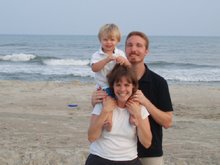
somewhere. I may be marching to heaven, or I may be marching to the grave. But in that march I am also marching to a better life here and now. My anxiety gives way to wisdom and faith; wisdom which identifies the roots of my anxiety, and faith which tells me that I have no better choice than to trust the universe to be good. My loneliness gives way to a wife who understands me and a child who adores me, just as I adore him. My restlessness gives way to a peace that passes all understanding.
Time keeps tickin' like a melancholy friend
Ticks the beginning and the middle and the end
But if I close my eyes and just pretend
There is shelter in this song
Like a river flowin' home...