Showing posts with label beach. Show all posts

Monday, August 14, 2006

Back From the Beach

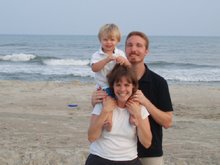
Last night Sami, Adam and I pulled into our driveway for the first time in 10 days. What a relief to finally be home. Of course we loved our time away, living it up in what could best be described as paradise. We had a beach-front cottage, and even our own tennis court. Peace and quiet were easy to come by, and the day to day anxieties were as far away as they ever get. But there's just something about home.

Home, for one thing, is safe. It is a familiar environment, and while it may have its fair share of problems, they are familiar problems, easy to manage problems. Problems you've dealt with before. There may be fewer problems on vacation (and then again, there may not be - I've been on some hellish trips), but when they arise they feel less like an expected part of your day and more like a conspiracy to suck all of the joy out of what should have been a perfect moment.

The American South, by and large, scares me. Being from Kentucky should have prepared me for the fear, bigotry and xenophobia that passes for local color or even common sense in some parts our nation; Kentucky is, after all, about as backwards a place as you can find. We now have a law, for instance, which (modeled after a similar law in Florida) makes it legal to use lethal force on anyone who enters your property without permission. I read a story in the New York Times about a man who, under this law, shot a neighbor during a heated discussion about, of all things, the number of trash cans you can put on your curb at any given moment. The gun wielding maniac in this story shot his victim in the stomach, then, while the victim lay bleeding on the ground, shot him again in the chest. The shooter cannot be prosecuted or even sued because his victim was an unwelcome guest on his property at the time of the shooting.

While this didn't happen in Kentucky, it easily could have. And, under our law, the shooter could not even be charged with a crime. So, having lived in Kentucky all my life, I should be used to a paranoid way of looking at the world which divided it into "us" and "them," the "good guys" and the "bad guys," "law-abiding citizens" and "criminals" who deserve whatever happens to them if they dare to cross those good gun-wielding citizens who so desperately deserve to protect their property from any perceived threat. But driving through the Carolinas, such a beautiful landscape, still scared me a little bit, particularly as I paid more attention to the various forms of cultural communication.

The best examples of these communications were found in Paradise itself, Holden Beach. As I've said before, my great-grandmother owned a home on Holden Beach until it was destroyed by a hurricane in 1954, the year my mother was born. My grandmother spent her childhood summers on the island, in that house. While she hasn't been back to Holden Beach since the hurricane which wiped out everything she knew and loved on the island, that beach still has a nearly mythic place in our family. It is a part of our collective identity. While no member of my family has owned land there in 52 years, that beach still in some small way feels like ours, a second home, even if we only visit it once a year. But despite that sense of belonging to the beach, and it belonging to us, while I was at Holden Beach this most recent trip I couldn't help but notice a shift, a cultural division.

Just off the island there are a couple of beach marts, one locally owned (actually, it is owned by one of the famous Holdens, after whom the island is named) and one a chain. The chain store is, at least according to its reputation in town (I can't confirm this) owned by an Arab. If ever there were an outsider in the American South at this point in our history, it is a person of Arab lineage. As such, the locally owned shop put up a big sign shortly after the new chain store opened, which reads:

Beach Mart
The Store With More American
"We Speak English and Pay Taxes"


Never mind that every business in America (except, perhaps, those corporate giants fortunate enough to be favored by the Bush administration, but that is another story) pays taxes. And never mind as well the fact that anyone who wishes to do business in Holden Beach had better speak some pretty good English. The sign in front of the local beach mart was specifically designed to capitalize on a racism which, as the so-called "war on terror" drags on, grows less and less subtle, less and less latent. Unable to compete with the chain store, the locally-owned one played the cards of race and fear.

Perhaps to counter this, or perhaps to tap into the cultural psyche of the area, the chain store has started flying a Confederate flag. They even has a t-shirt for sale, which, after showing a picture of a Confederate flag waving proudly in the wind, read:

If You're Offended By This
You Need a History Lesson


Personally I think that anyone who simultaneously wraps themselves in the cloth of patriotism and flies the flag of open rebellion against the United States needs much more than just the history lesson they promise to those who call them on the bigotry and treason represented by that flag. As it stands, I couldn't spend my little money in either store. Both appealed to our worst instincts; both preyed on and profited from our culture of fear.

But the two stores, across the street from each other, stand next to the greatest place on earth, a locally owned miniature golf course which also makes its own ice cream and waffle cones. I can still feel that sweet taste oh heaven on my lips, in my mouth. I am a sucker for ice cream, even ripping off the Bay City Rollers with my own

I-C-E-C-R-E-A-M! (to the tune of S-A-T-U-R-D-A-Y!)

pestering my wife with a constant barrage of musical odes to ice cream.

But not all of the culinary treats of the beach worked out quite so well. It turns out, after years of a vegetarian diet, I can't even eat seafood once a year anymore. I tried it twice, and twice I got violently ill. We were so close to the semi-legendary town of Calabash, by the North Carolina/South Carolina border, that I could almost taste their famous fried seafood, in a much lighter batter than most other places. Picture, if you will, hush puppies that are closer to Krispy Kreme doughnuts than anything else. So light, so buttery, so sweet that they simply can't be good for you. Now picture that same batter on every kind of seafood imaginable. If you ask for your fish broiled they look at you the same disgusted and condescending way that the waiter in London looked at me when, an ignorant and arrogant American teenager, I asked for iced tea.

So close to Calabash, but my days of eating seafood seem finally over. Looks like I won't cheat on my vegetarianism (if there is such a word) once a year any more.

Coming home from dinner one night I saw a bumper sticker which reminded me of the way in which fear, hatred, and the worst sort of xenophobia pretending to be patriotism so dominate political discourse, particularly in the no-longer-familiar-to-me American South. It featured a menacing picture of Uncle Sam, pointing his finger straight, it seemed, at me, saying:

America:
Love it, or Leave It!


Surrounded as it was by anti-leftist propaganda stickers, its message was clear: People who disagree with the politics of the owner of that vehicle are guilty of nothing less than hating America, if not outright treason. Of course my politics, which often question American policies and motives, as well as the morality of our prosecution of wars, comes out of a deep seated love for my country; a love so deep that it is willing to stand up and say that we are on the wrong path, and need to change direction before we harm ourselves and others any further.

Coming of age, and coming to faith, in a conservative evangelical setting, I was often told that true love is the ability to point out to someone how wrong they are, in the hopes that they will change their ways. This doesn't often work out so well in interpersonal relationships. As a teenager I could never convince the people that I loved that they should change their ways to avoid the fires of hell. But there are times when I feel the impulse to engage my country with that sort of evangelical love. If I didn't love my country so much I might leave it. But I wouldn't leave it just because some bumper sticker told me to.

After a week on the beach we drove home through some small South Carolina roads. We drove through many depressed small southern towns, full of the insecurity which gives rise to the politics of fear. Many of the subtle cultural messages I got from signs, stores and bumper stickers in Holden Beach were more apparent in these economically desperate areas. They reminded me of the small town in Kentucky with the church I used to pastor. The town had few jobs, and limited prospects for keeping the kids who grew up there. Most skipped town after high school, either going to school or heading to Lexington or Louisville or some other more populated area to try to find a job. But that church, in that town, had little appreciation for the socioloical and socio-economic factors which caused them to constantly lose their young people. Seeing themselves as the last remnant of a dying way of life, they placed themselves in the midst of a cosmic war between good and evil, us and them.

That same way of thinking permeates many depressed and isolated areas throughout the south. It becomes part of the culture fabric and religious mythos. And as the divide between the haves and the have-nots deepens, as these "good" people become more and more isolated from the rest of society, more and more economically depressed and emotionally despondent, the spiritual war that they wage against an immaterial evil represented in part by hyper-educated city liberals like myself my grow more and more physical.

I'm not trying to sound paranoid, nor am I trying to detract from the great joy that was my vacation. But as I drove through the rural south on my way home, my mind filled with the xenophobic images I had already encountered, I couldn't help but fear that the Christian fundamentalism emerging from these areas could, in a perfect storm of sociological, psychological, theological and economic factors, become much more like the Islamic fundamentalism that so threatens global safety.

It is good to be back in the religiously and culturally pluriform city. It is good to be back in the safety of home. But if I allow myself to retreat to far into this emotionally safe place, I may miss the potential escalation of the culture wars.

Friday, August 04, 2006

Beach-Bound Bum on Blogging Break

One of my wife's biggest objections to my career as a minister was that I would never really come home from work. Sure, my body would from time to time enter her house, but it had never really left work. It had only moved from one office to another office. I was always working on a lesson or a sermon or an event or some other ministerial need.

I started this blog at the end of last October as a way to channel the energy that I had been putting into ministry. Since then I have never gone more than two or three days without writing something, be it a comment or a new post, for this blog.

That's about to change. In about two hours I am leaving for the beach. OK, not exactly the beach - I'm actually headed to Lexington to meet up with my mother. We'll leave from Lexington tomorrow morning to go to Chapel Hill, NC, home of both the University of North Carolina Tar Heels (I still don't know what a Tar Heel is, any more than - despite being part of the Indiana University Alumni Association - I know what a Hoosier is) and my maternal grandparents. We then leave from Chapel Hill on Sunday, bound for Holden Beach, a quaint and quiet beach just about a half-an-hour's drive north of Myrtle Beach, SC.

Holden Beach is also right by Calabash, home to some of the most distinctive seafood in the world. As such, once a year I get to be a hypocrite, and actually eat a dead animal. I know, I know, for shame and all that. But one week per year this vegetarian cuts loose and eats seafood.

Anyway, we'll be at Holden Beach through Saturday, arriving home either Saturday night or Sunday afternoon, depending on how long we feel like driving with a cranky kid. So, by my count that should be just over a week without any sort of Internet connection, which should be enough to drive this former workoholic turned serial blogger a smidge stir-crazy.

In other words, it should be more than a little bit good for me.

Holden Beach, here I come! I'll see you (figuratively, anyway) good folks in the blogosphere when I get back.

Thursday, August 03, 2006

Beach Reading II: The Verdict

We're heading out tomorrow, though I should post one more time before we leave. Sami and I are doing most of the packing tonight before bed. I came downstairs a few moments ago, into my basement office/study/library, to finally choose the books I'm taking with me (I think). As soon as I finish typing this, I'm packing the books mentioned here, which will hopefully finalize my decision.

Anyway, here's what I've decided, unless I change my mind sometime before the van finally pulls out of our driveway after Sami gets home from work tomorrow.

Lee, Harper; To Kill a Mockingbird. I saw this sitting on my much neglected "Fiction" bookshelf, and just had to bring it. I've read it so many times that I know the story, and many of the lines, by heart. But Sami just told me that she didn't know what she was going to read at the beach, and when I saw this I thought of her. If I don't read it, maybe she will. Also, Tom is sure to point out, the play based on this book produced a great coincidence. Our senior year of high school both Henry Clay and Lafayette, two public high schools in Fayette County, put on the play. Henry Clay did it first, casting me as Boo Radley. Lafayette then performed it later in the year, after Tom had transferred there for reasons beyond my understanding (he transferred in the final semester of his senior year!), casting him, my identical twin, as Boo Radley. I say he overacted the part, he says I underacted it. Anyway, it is a timeless classic that deserves to be dusted off from time to time. Easy to read, and it gets even better with age.

Teilhard de Chardin, Pierre; Christianity and Evolution. A collection of essays unpublished in his lifetime. Written by a Jesuit and a scientist, many of these essays concern the relationship between science and religion. Every time I read Teilhard de Chardin, I get about twenty pages in and then completely lose focus. He is such a dense writer and such a complex thinker, I'm ashamed to admit that I can't keep up. But the essays in this book are reasonably short, so I figure that by the time I've lost focus I'll have about finished the essay I'm reading, and won't have to keep up with his argument any longer. The key essay, "The God of Evolution," looks at the theological implications of Darwin's theory and subsequent scientific findings. In short, it casts a new vision of God, using the revelatory nature of science to help aid the theology. Not for those obsessed with orthodoxy, but a must read for anyone who wishes to see the way in which science pushes religion, and vice versa.

Griffith-Jones, Robin; The Four Witnesses. The lone holdover from my earlier list, I picked this book because I'll be preaching again at the end of the month, and would like to have some fresh thoughts on the Gospels. My last series on the Gospels was a look at how Marcus Borg's theory of Jesus' shifting of the focus of religion from purity to compassion informs our reading of some stories in Mark. I'm not sure that this book will yield such sweet fruit, but you never know.

Alexander, Lloyd; The Chronicles of Prydain. This isn't a single book, but a set of books which helped define my childhood. Before I read Lewis or L'Engle or Tolkien, or even Bradbury or Asimov or MacDonald, I read these books by Lloyd Alexander. Based in part on Welsh mythology, The Book of Three, The Black Cauldron, The Castle of Llyr, Taran Wanderer, and The High King follow the adventures of an Assistant Pig-Keeper named Taran, as he wanders through the mythical land of Prydain, trying to find himself. Taran dreams of being a hero, only to have his dreams dashed by the ignoble reality of armed conflict. Broken, he his redeemed, the story of humanity. These books, which are responsible for the darkest Disney cartoon ever, helped me dream the dreams that made my childhood tolerable. I'm taking them with me to the beach, because I re-read them every five years or so, and it is about that time.

Tuesday, August 01, 2006

Beach Reading

At least one very good thing has come from my being removed from consideration for the job with the Peace Education Program: I'm going to the beach.

My family has long had a special connection to Holden Beach, North Carolina. Just about half an hour by car from the more popular (and touristy) Myrtle Beach, Holden, sitting on an island between the Inland Waterway and the Atlantic Ocean, is a quaint and quiet beach, perfect for relaxing and focusing the mind. My Mom's family is from North Carolina, and her maternal grandmother owned a cottage on Holden Beach; a cottage which was destroyed in a 1954 hurricane, forever ridding her family of the desire to own beach-front property.

Almost every year my mother rents a beach house for a week, inviting whoever from our clan who wishes to go to share the week with her. Because the application process for the Peace Education Program job was such an extended one I was afraid that this year I wouldn't be able to make the trip. Truth be told, I was even hoping that this year I wouldn't be able to make the trip, because that would mean, of course, that I either had a job that I wanted, or was very close to having a job that I wanted. But having gone through the disappointment that invariably comes with even the most well reasoned rejection, now I'm ready to hit the beach.

Because Holden's peaceful ambiance is perfect for focusing the mind, I always bring with me a book that I've struggled to read in the chaos of Louisville (I know, those of you who live in New York or Chicago are wondering just how chaotic my piddly little city can get, but chaos is relative). On each of the last two trips to Holden I've brought books by Paul Tillich. Last year I worked through Theology of Culture, and in 2003 (we didn't get to go to Holden in 2004, because it was being threatened by a hurricane the week we'd planned to go that year) I was enchanted by The Shaking of the Foundations, his book of sermons.

This year I've got a couple of candidates from Tillich - perhaps Morality and Beyond or What is Religion? - but I'm not sure I want to continue the tradition of wrestling with Tillich at the beach. Perhaps I should branch out. So, I'm putting together a short list of some of the books that for one reason or another I haven't gotten around to reading; books that would do well in the relaxed, centering atmosphere of Holden Beach. If you see one on this list that you think I just absolutely have to take with me, let me know:

Bonhoeffer, Dietrich; Ethics. I started reading this about four or five years ago, and never finished. I got enough into it to have a pretty good idea of where I thought he was going, but then, frankly, I got bored. I don't know if that was the fault of the book - much of which was written in prison and wasn't published until after his death - or the fault of the inattentiveness of youth. Anyway, at some point I'm going to take another crack at it.

Wustenberg, Ralf K.; A Theology of Life: Dietrich Bonhoeffer's Religionless Christianity. I saw this in a used bookstore in the winter of 2004/2005, just before Adam was born. The thesis intrigued me. Because Bonhoeffer died so young, leaving so much of his thought unexplained, so much has been written by scholars trying to explain what Bonhoeffer might have been thinking. He was a work in progress, cut down far too soon. I read the first chapter, which hooked me. But then school started back, and Adam was born, and life spiraled out of control and I never looked back at the book.

Ellis, Marc H.; Ending Auschwitz: The Future of Jewish and Christian Life. You can often pick up scholarly religious works on the remainders market. I saw this book, written by the Professor of Religion, Culture, and Society Studies and Director of the Justice and Peace Program at Maryknoll School of Theology, in a temporary book store in the mall for maybe $2, and took a chance on it. I haven't found the time to read it yet.

Griffith-Jones, Robin; The Four Witnesses. A book by an Anglican priest comparing and contrasting the four canonical Gospels, this was actually written in John Wesley's study at Oxford, so I had to get it. The author was a chaplain who also taught New Testament at Lincoln College, Oxford University, before being named Master of the Temple Church in London. This has been sitting in my library for maybe four and a half years, and I still haven't read a word of it.

Kung, Hans; Justification: The Doctrine of Karl Barth and a Catholic Reflection. I first read of this book in Kung's memoir, My Struggle for Freedom, which I got for Christmas 2003. It was one of his two doctoral dissertations written as a student at the German University in the Vatican. While writing it he had the unique opportunity to dialogue with an elderly Barth on his own writing. After reading the finished work, it is said that Barth remarked that Kung understood him better than he understood himself. A landmark work in ecumenical theology, I haven't yet had the courage to tackle this epic.

Morgan, Robin; The Demon Lover: The Roots of Terrorism. Finally, a non-theological book! Not only is the remainders market great for finding cheap books by religious academics, it is also a great place to pick up a book you would never think of buying otherwise. I bought this feminist critique or patriarchal societies for $1 just a couple of months ago. I don't know much about it, except that it was originally published in 1989, and then reissued with a new introduction after 9-11. Oh, yeah, and according to the front cover, Gloria Steinem loved it.

Palmo, Ani Tenzin; Reflections on a Mountain Lake: Teachings on Practical Buddhism. This was one of the texts for my Buddhist philosophy class my final semester as a college student. I skimmed the sections which were assigned in class, and was impressed by them. However, I was only skimming (Adam was born that semester, remember?) and the assigned readings covered less than a quarter of the book. The author, born in London, was among the first Western women to be ordained as a Tibetan Buddhist nun.

Segal, Ronald; The Black Diaspora: Five Centuries of the Black Experience Outside Africa. Another remainders market purchase. The word diaspora, a Greek word which means roughly "scattering," was first applied to the Jewish experience. The Septuagint, for instance, is a product of the Jewish diaspora, compiled by Alexandrian Jews who wanted to be able to read their sacred texts despite the gradual loss of the Hebrew language from their community. If anyone's experience mirrors the diaspora, the "scattering" of the remnants of ancient Israel, it is the scattered population of those stolen from Africa. This book, a look at diasporic black culture, was written by the former editor and publisher of Africa South, a South African who left the country for political exile in England.

Teilhard de Chardin, Pierre; The Phenomenon of Man. Forgive the lack of inclusive language in the title, this was first published by the famous Jesuit scientist and theologian (so disowned by his beloved Roman Catholic Church for his explorations of the theological implications of Darwin's theory of evolution by natural selection that he was unceremoniously buried in an unmarked grave despite devoting his life to the service of the church) in 1955, and was first translated into English in 1959. It is truly a product of its time, which is rare for theological works, which often dialogue with the past but not the present. I first became interested in Telihard's work reading an essay in Thomas Merton's Love and Living which attempted to redeem Telihard for Catholics. Of course, having Merton vouch for your orthodoxy may just seal your fate as a heretic. I haven't yet read this particular work, but I have read some of his others, and can honestly say that I don't yet have the foggiest idea what he is talking about. That is the danger of reading on your own.

Of course, my brother, who in asking me this weekend what I was going to read at the beach, will chastise me for coming up with such a lofty list. After all, while I was reading Tillich last year, he and my wife we pouring through my copies of the Chronicles of Narnia. So, if you'd like to see me pick some lighter reading this year, you are welcome to suggest one.